
Native Justice Workshop and Niskithe Notes
Registration Ends Wednesday!
Roots of Injustice, Seeds of Change:
Towards Right Relationship with Native Peoples
Saturday, May 2nd, 1-3pm
Shalom Spirituality Center (1001 Davis St., Dubuque, Iowa)
This Saturday, award-winning Lakota journalist Kevin Abourezk—co-leader of Niskithe Prayer Camp (a partner of HNLF… see below)—will be in Dubuque, IA, to co-facilitate a powerful, in-person workshop that explores the foundational and ongoing legacy of the Doctrine of Discovery. Through experiential exercises and discussion, the workshop—developed in response to calls from Indigenous leaders at the United Nations and the World Council of Churches—will take us through the history of the colonization of this land and look toward how non-Native people might pursue right relationship with Native poeples. Registration ends Wednesday, April 29 — RSVP today!!
The below reflection was published on April 21 by Eric Anglada for his Embracing Repair Substack…
Niskithe Prayer Camp
In western Iowa last weekend, some friends and I joined a circle of more than 50 people gathered among rolling hills dotted with burr oaks and tipis at the Niskithe Prayer Camp. The camp is an Indigenous-led, multi-racial space featuring talks, ceremony, song, sharing circles, and a feast of “pre-contact” Native foods provided by the great Chef Anthony Warrior. Though this was not the first encampment of this group of people, who are based in and around Lincoln, NE and co-led by Renee San Souci (Omaha) and Kevin Abouresk (Lakota), they do not have land of their own. The collective, which has had to rely on the generosity of white land owners to provide spaces where they can facilitate their healing ceremonies, is actively fundraising and looking for land to build an eco-village centered on healing, gardening, ceremony, cultural revitalization, and housing for Lincoln’s urban native population.
This gathering is perhaps the most impressive and important decolonial collective space I have encountered.
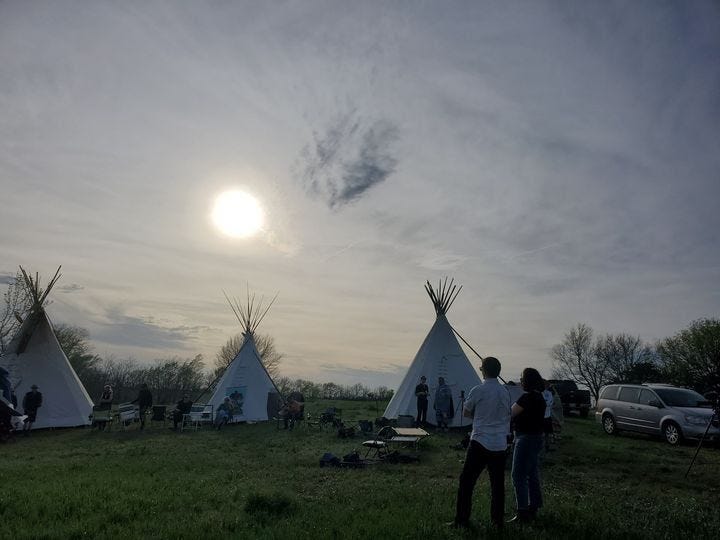
Since 1978, when Native religion stopped being considered illegal by the U.S. government (!), the Indigenous community in Lincoln, Nebraska had utilized land owned by the Catholic Church for sweat lodges, prayer, gathering, and ceremony. In 2022, that land was suddenly and devastatingly sold out from under them, and the Native community was faced with eviction. A 16-day encampment ensued, resisting the loss - yet again - of their sacred land. Though the protesters failed to stop the sale or the development of the land, the momentum they created has birthed Niskithe - twice-a-year encampments open to both Native and non-Native folks to learn, build community, and work toward “land reunion.”
This was my third time as part of the camp. One recurring highlight has been to experience the all-Indigenous, pre-1492 foods shared by Chef Anthony Warrior (Absentee Shawnee). During the blessing of the food, Chef Anthony ensures it rests on the ground “from where this came.” This past weekend, the satiating feast featured bison broth as the foundation of a three sisters soup of corn, beans, and squash. There were berries and fish and fellowship. “Food is medicine,” Chef Anthony kept saying, offering his own testimonial of how he has been healed by the foods that this land and her original inhabitants have known for millenia.
But perhaps more than this feasting, what sticks out to me from the experience is an opportunity, as a white person, to move from being a settler (who replaces original inhabitants) to an immigrant (who seeks to assimilate to the original inhabitants). To learn about and be taught protocols, lifeways, and values that have existed in this land for millenia - what direction is appropriate to walk around the sacred fire, what dress is appropriate, what plants are important, how to honor water. This is all part of this journey of decolonization.
While this encampment continues to pop up in different places, the vision of a more permanent presence near Lincoln remains. Kevin Abourezk writes, “The village will serve as a means of repairing the Sacred Hoop of Indigenous people broken by genocide and forced assimilation by allowing [us] to live and pray the way [we] want on lands of [our] own.” He also writes of his dream that he had near the end of the camp a year ago:
“When dawn broke on that fourth day, adults and children emerged from their tipis. Mothers and fathers gathered at the cook shack while children laughed and chased one another through the green grass and wild flowers. The birds sang and all of nature celebrated the return of a lost tribe. Our elders have spoken of the sacred hoop being broken at Wounded Knee and how it would take seven generations to remake the hoop. That Sunday morning I knew the hoop had been remade.”
To conclude the talking circle last Saturday, one young Indigenous man spoke powerfully: “We need land back. It’s not just for us, it’s for all of us.”